






I visited most of the major bread bakeries in San Francisco in August last year and did not like any of the sourdoughs that I sampled except Chad Robertson’s Country Sourdough. Taste for bread is very individual. I have given up looking for nice sourdough from shops. If I want bread, I make bread in my own kitchen but my own results are never consistent. I have good days and bad days.
When I turned up at Sonoma Bakery Café in Paddington, Sydney, a few days ago, I really wasn’t expecting much. I had to be in Sydney for a day and so I was just filling up my time.

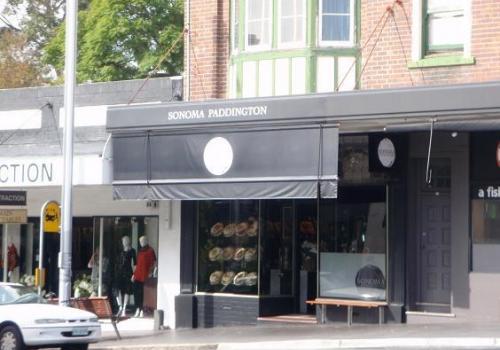
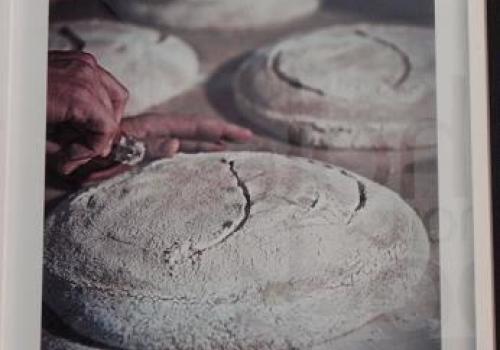
This window display got my heart pumping:

I stood in front of the window with my jaw dropped to the ground at the sight of these giant Miches!! Unbelievable! I am actually quite easily excitable.


So, who buys these giant (1.9kg) Miches at A$14.00 per piece? I do.

It was worth every cent of it.

It was much later in that day when I realized that Sonoma Paddington is right around the corner from my good friend, Jan of Pastilla Nash, whose delightful Prune and Walnut Log is served at Tetsuya’s restaurant along side sourdough from Sonoma Baking Company.
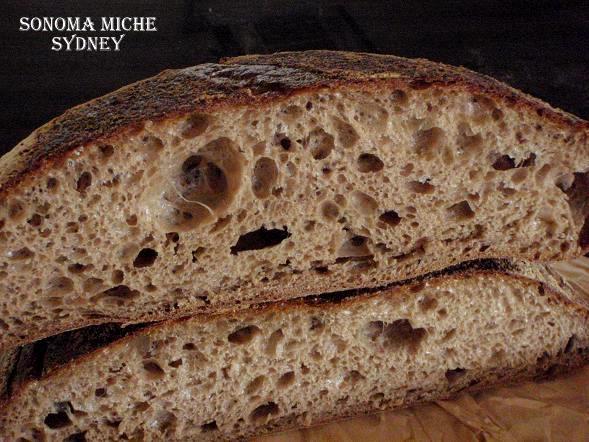
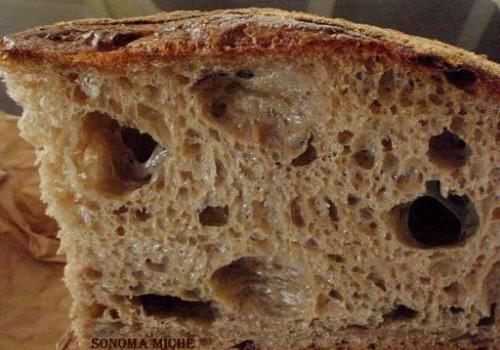
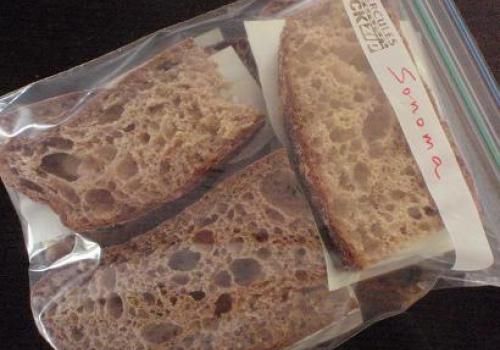
The crumb is [b]translucent[/b] throughout (as seen below)– there is the vestige of fermentation on each and every cell. Every single cell is aerated. It is soft and spongy, mildly chewy, and mildly sour.


On the way home to Brisbane, somehow Chad Robertson came to mind. I don’t know why. It is not so much that I could recognize any similarities between Sonoma Miche and Chad Robertson’s Country Sourdough, but perhaps it is more because the excitement that I experienced in both breads was the same. As soon as I got home, I went onto Sonoma’s website and this is what I found:
[color=blue]"Andrew and Christian Connole, inspired by the artisan sourdough baking of Northern California…. The Connole boys immersed themselves in the baking fraternity of the San Francisco Bay area where they learnt to bake from renowned artisan bakers like Chad Robertson ….”[/color] Ah ha!
In fact, I like Sonoma Miche much better. It is rustic on the outside, but the crumb on the inside is very delicate. Chad’s Country Sourdough, on the other hand, is more what its name indicates. To achieve this delicate crumb, Andrew Connole says, “At Sonoma we prolong the fermentation process by chilling the doughs as they rise,” and that “These specially tempered doughs … are gently mixed and hand shaped before being given a lengthy fermentation in our retarder.”
The next day after I got home, I had 1/4 of this Miche with my kids. I sliced 1/2 of this Miche and placed the slices in a zipped locked bag and placed the bag in the freezer.


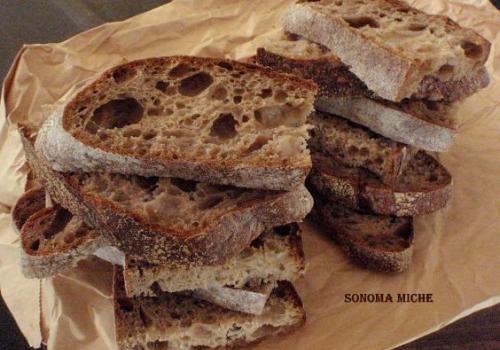
I kept the remaining 1/4 in another zipped locked bag at room temperature and my kids and I sliced it for breakfast on the third day. The crumb was still incredibly moist!! It was amazing. None of the sourdoughs that I had ever tasted were as moist as this. I like my sourdough very moist. Despite what most people say about sourdough’s good keeping quality, I rarely have sourdough without it being toasted if it is more than a day old. I am surprised that I am happy with the crumb of Sonoma Miche [b]as is[/b] even on day three! I need not have to freeze half of the Miche after all.
Sonoma Paddington – what a treat!
Shiao-Ping
p.s. Andrew Connole talks about his bakery in youtube: here
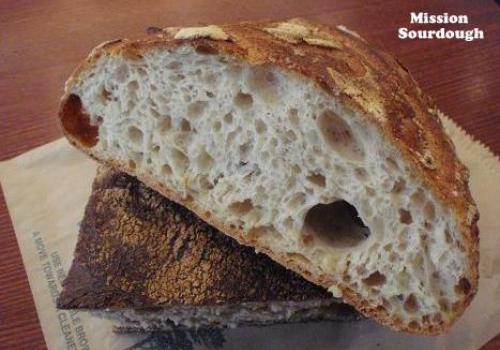
p.p.s. The white version of Sonoma Miche (Miche Sourdough) is Mission Sourdough which is more than a foot long:


Replies
A couple of comments.
Firstly, if your bread-baking results are inconsistent, I can only imagine that's because of your constant experimentation with new doughs and techniques. I would not put myself in your class as a home baker, but my regular breads are very consistent. I suspect that's because I am less adventurous than you, and content to keep baking the same favourite breads over and over, perhaps with little tweaks to try to get them as close to the ideal as possible (typical plodding Taurean). In between my regulars I do try new ones - many, if not mostly, from your innovative recipes.
As always, there are plusses and minuses whatever stance you take. Constant experimentation means stimulating baking and some spectacular successes as you break through new boundaries. Repeating the same breads while seeking to attain an ideal through small tweaks probably leads to consistent results, but less exciting baking! You never can have it all, can ya?
To the main content of your post: I'm really intrigued by this miche as you describe it. That transluscent crumb looks incredible. I wonder how they have managed to create a SD bread that maintains a fresh crust so long (hopefully, they don't use any preservative)? Do you think it's all down to the controlled temperatures they prove at?
Cheers
Ross
Shao-ping,
Thank you for your post & pictures. I have gotten what you call translucent crumb and was thinking I was doing something wrong. In the beginning of my sourdough adventures I thought the goal was small, consistent crumb size (didn't even know the term crumb didn't just refer to what was left on the board after slicing!).
Then I found this site and a couple of others that have been so helpful in teaching me what results I should be looking for. Now I know when to smile & when to say "drat!" & go back to the bread board.
I can identify with the idea of $14.00 for a loaf of bread...several years ago I was visiting Seattle and went into the Grand Central Bakery...worth every cent :-)
Toni
Hi Ross, You have a good point. I do experimenting on new recipes and new formulae a lot.
On the [b]translucent[/b] crumb, my photos do not show the [b]paper thin[/b] quality of their crumb. I read their website very carefully, but all that I could get out was that they use NO commercial yeast. No, I do not think that “it's all down to the controlled temperatures they prove at,” but I do think that the way they ferment their dough is the key reason for their success. You could see from my photos that their crumb color is quite dark. In fact, I should say it is very dark. The last time I got that crumb color was from a pure rye sour (my Pure Sourdough Rye, year 1939) where the rye flour went through a series of fermentation stages to get to that color. Sonoma Miche would not have a high content in rye, or there would be no volume or structure in their dough. Are you familiar with how real estate agents talk about their real estate? Sometimes it is not important what they say; it is more important what they don’t say. Recently I got hold of a few very old bread books, one of which tried to emulate the famed Poilane miche where [b]cocoa powder[/b] was added for the coloring. Can you believe that? Cocoa powder!
I had a slice toasted this morning for brekky. Their crust is truly amazing. You can get crunchiness out of most sourdough breads easily. But to get it at the same time when it is also delicate and [b]light[/b], it is not easy. Their crust also has a [b]paper thin[/b] feel about it because it is very [b]light[/b].
Hello Shiao
Nice post on the Sonoma miche bread- would you have the recipe for baking the Sonoma mission bread. Or the recipe that is equilavent to this
regards
nunzi
Wish I had cause (and funds!) to be in Sydney soon so I could try one of their loaves and experience first-hand what you describe!
BTW, my consistency has taken a turn I'd rather it didn't. I have been consistently (last 7 bakes!) turning out loaves that burst through a slash, or sometimes even the seam on the bottom. This has never happened before and it's got me stumped. I put a post on TFL seeking advice, but so far haven't pinned down the problem. Maybe it's one for the Queen of Home Sourdough Bakers [low bow, elaborate hand flourishes etc]...any ideas, perchance?
Cheers
Ross
Hey Ross, doesnt that just show you how sourdough is an organic process....im always suspicious of uniformity, life just isnt like that, and even when i ran thousands of breads through my woodfired ovens in Melbourne, sometimes there was inexplicable non-conformity, which i grew to really appreciate and realise it was one of the great parts about sourdough.......this is character!
Ross have you tried proofing the dough a little bit longer?
Yes, that was one of the suggestions from the TFL thread that I took up in yesterday's bake - same bursting phenomenon occurred. I think I'll try again with a MUCH longer proof period, just to see what difference it makes.
Just curious, Duane - do you do a poke test or anything like that to assess whether your dough is ready? Must admit, I just go by the look of the dough and the clock, but I may have to get more conscientious about checking dough readiness in other ways...still, it's puzzling I've never had this problem until now, and that since it started 3 or so weeks ago it just keeps happening!
You have had almost the whole world of TFLoafers behind you helping - Andy of ananda, Paul of PMcCool, Eric of ehanner, Hansjoakim, Don of DonD, AND Mini Oven!!
The same thing has happened to me before. My own observations are as follows (sorry, I did not read any of the comments you’ve got, so if there is any duplication, please excuse me):
(1) The bursting out of the crust shows quite obviously that there was a strong force underneath (sorry, stating the obvious). That often happens when (a) the overall hydration of the dough is low (rather than high); and (b) the starter is very strong AND has not had a full chance of fermenting all the sugar in the starch (the dough being a low hydration dough means there is more flour, more food vis-à-vis the little beasties feasting on them). Because the wild beasties have not fully digested what is available to them, they are still going very strong, like a teen-ager who is about to reach prime, but not yet.
You know very well that in order to have attractive “grigne” and a good oven spring, it is better to under-proof the dough, rather than over-proofing it. You might however, have erred on the extreme under-proof. If I were you, I would prove my dough a bit longer time, eg. at least two hours in the current cooler weather or at the bulk fermentation stage – same thing (I am working on a total fermentation time basis).
(2) The second set of reasons concerns the more technical aspects of the loaf – the scoring and the shaping. Your scoring may be uneven, meaning your three slashes are not equal depth (the bursting happened at the deepest slash because the other two slashes are not deep / open enough to share the up-thrush of the oven spring. Or, your final shaping may be uneven - that one side is shaped tighter than the other and the bursting happens where the shaping is tighter. Sometimes I find that the problem started from when I was diluting the starter in water for the final dough – that it was not diluted evenly and that there were lumps.
In my own experience the first set of reasons above is more the real reason why bursting out of the crust happened. For me it happened in dryer doughs because dryer dough needed longer fermentation time (the wild beasties were not able to get at the starch as quickly and easily as in more liquid dough) but I overlooked it.
I have just read LeadDog's comment and your reply. Your reply made me think that it is the cooler weather over the last 2 - 3 weeks that did it. In one of my posts (can't remember it is a recipe or a blog post) here at Sourdough.com that I said that with that particular bread that I made, it had 4 hours bulk ferment and 6 hours proof at room temp!! A month ago if somebody had told me that their dough was fermented this long, I would say you were mad!
My experience every time when the bursting out of the crust had happened, the crumb was not nice (for the simple reason that the dough had not been fermented enough) - the crumb tasted a little bit dry; there might be big holes but on the whole the crumb was dense.
Ross I use the poke test. You have covered why the bread is now bursting but my guess is just a little bit of change in the weather towards the cooler side is what has happened. Enjoy the longer fermentations you will get more flavor out of your bread. I know I'm looking forward to our next winter here.
[quote=shiao-ping]
On the [b]translucent[/b] crumb, my photos do not show the [b]paper thin[/b] quality of their crumb. I read their website very carefully, but all that I could get out was that they use NO commercial yeast. No, I do not think that “it's all down to the controlled temperatures they prove at,” but I do think that the way they ferment their dough is the key reason for their success.[/quote]
That type of crumb is usually associated with a very high water content, a very 'strong' flour - gluten enriched, high protein flour (HP) - and low intensity mixing with long fermentation. But I'd say high water & high protein.
[quote=shiao-ping] You could see from my photos that their crumb color is quite dark. In fact, I should say it is very dark. The last time I got that crumb color was from a pure rye sour (my Pure Sourdough Rye, year 1939) where the rye flour went through a series of fermentation stages to get to that color. Sonoma Miche would not have a high content in rye, or there would be no volume or structure in their dough. Are you familiar with how real estate agents talk about their real estate? Sometimes it is not important what they say; it is more important what they don’t say. Recently I got hold of a few very old bread books, one of which tried to emulate the famed Poilane miche where [b]cocoa powder[/b] was added for the coloring. Can you believe that? Cocoa powder! [/quote]
The high water content will enhance diastatic enzyme activity degrading a significant portion of the flour starch producing the soluble sugar maltose. Since maltose is soluble the dough water that would be held or absorbed by the gelatinised/pasty starch is liberated when the complex starch is degraded into maltose. Thus there is a significant production of maltose & liberated water. This results in a very moist crumb (see above) and also with a dark caramelised but sweetish crumb & crust. I'd be tempted to bet a reasonable portion of wholemeal rye is soaked overnight to facilitate the development of maltose to caramelise on baking and produce a moist glossy crumb. Since a significant portion of the total flour is probably rye - soaking wheat produces maltose but not to the extent that rye does & the colour of whole wheat bread never reaches the dark colour of rye I also think the wheat flour would be strong or HP or even gluten added. Remember many French breads are made with Manitoba type flours; the French import a lot of their premium wheat bread flours from Canada.
[/quote]
The low intensity mixing in combination with the high water content and good longish floor times makes the crumb structure very like the photos show.
Good luck.
Im working in the UK at the moment, and have been here on various assignments in the last 3 years. What amazed me when I first made bread here was the colour of the wheat. A 100% wholemeal made from all British flour looks like what we would call a rye bread in Australia! The flour here is that much darker, especially evident in the wholemeals. When one examines the wheats here, they look nothing like Australian wheats which are usually yellow and golden"white" wheats. The strong Canadian flours as Danubian says can also have this colour, which is almost impossible with Australian flours...well ive never seen it....and wholemeals made from the Canadian flour (or nth American) here, have this colour as well, and ive also noticed this colour in US breads, again, one never sees it with Australian flour/wheats. Using rye is definitely one way to achieve it, especially as Danubian describes, another is to simply add non-diastatic malt to the dough. This will not be completely metabolised by the bacteria in a sourdough (the yeasts tend to be non-maltose fermenting), so there is residual maltose at the completion of fermentation and this shows in the finished loaf as highly coloured sweet crust, and may give darker crumb colour also conferring moistness to the loaf.
The Sonoma breads are really quite brilliant, but I re-iterate they and the American ones like them (also from Berkshire Mountain bakery, Richard Boudin is the real (and humble) innovator of this style) are a new genre of sourdough, which is a very interesting development. Here in the UK as well, the larger sourdough bakeries rely on retarder-prover technology which fills the gap as far as demand goes, but it leaves me cold (pun intended).
Thank you so much for your comment. You have given me a great tip for my next experiment. For all the bread styles that I have tried, miche is still my most favourite. I remember your great Forum post: "Dark" or "Black" colour to rye bread. Thank you again.
Cool blog Shiao-ping...
Just to clarify, Sonoma miche is made from organic white, wholemeal and malted barley flours. It has no preservatives and no rye flour. Its made using preferments, Sonoma's own style of autolyse and has a very long floor time and final ferment at low temps.
Good luck with your experiments
... and to clarify. It is very interesting that the Sonoma Miche crumb color is due to the malted barley flours and your special way of perfermenting. I made a small miche in my cast iron cooker bought in a camping store the other day:
[IMG]http://i567.photobucket.com/albums/ss116/shiaopinghu/100.jpg[/IMG]
[IMG]http://i567.photobucket.com/albums/ss116/shiaopinghu/101.jpg[/IMG]
[IMG]http://i567.photobucket.com/albums/ss116/shiaopinghu/102.jpg[/IMG]
The color was from 5% palm sugar. I have been cooking a lot of Thai curry lately and love the aroma and taste of palm sugar, so added it in. The wild yeasts absolutely loved the palm sugar as all cells of this bread were aerated and the texture was very light… like your miche. I was very pleased with this find.
Shiao-Ping
Hi Shiao-Ping . . . did i miss the recipe for this miche you baked in your camp oven? couldn't find it. can you post it please? looks delightful. thanks, caterina
And by the look of that terrfic crumb, chalk this one up as yet another successful S-P experiment! Your innovations are always inspirational for me.
I'm very into Thai cooking, also, and have a supply of palm sugar in constant store. Never thought of using it in bread, though. Gotta try this!
Cheers!
R
Hi R
The yeast is so happy with 5% palm sugar - the crumb has a very mild caramelised smell but you cannot detect any extra sweetness in taste to it. With the sugar, the dough will ferment a bit faster than normal. From the moment my dough was mixed to the time I placed it into the fridge for overnight sleep, it was about 4 hours at temperature of around 25 degree C (the dough had risen about 1/2 - 2/3). If your dough is very wabbly when you place it into the fridge it has over-fermented!
Have fun!
Shiao-Ping
That bread looks amazing. Reminds me of some bread that Chad has in his book Tartine Bread. He had some home bakers try his recipes out and the results are similar to yours.
You should look into making bread professionally, its always nice to see someone with so much passion for good bread.
Jordan
Hi Jordan
I love baking, all kinds of baking, but I know my limit. There is a beautiful little cafe down near where I live, the lady, Phil, who owns it, makes delicious Spanish toastes and toastes with lots of avo, lemon and pepper. I love the hippie, free, and artsy spirit there and go there a lot. Phil asked me one day if I could supply sourdough to her cafe. I said I could give away but I could not supply because I have no consistency. Thanks for your comment. Shiao-Ping
Spot on, Shiao-Ping. I firmly believe that once you know what you're doing as a home baker of sourdough, and providing you use good recipes and top quality ingredients, it's entirely possible to turn out bread that is right up with the best in terms of flavour and texture. And people like you are also well capable of matching the pros aesthetically, as well.
BUT, consistency is the great point of differentiation between the amateur and pro baker. I suspect it's all down to the extra control commercial equipment makes possible - and experience. A commercial baker shapes and bakes more bread in a day than the average keen home baker would do in a year.
I have no doubt at all that in terms of talent you are in the top percentile of bakers, amateur or professional, but there's a great gulf between the amateur and professional artisan baking worlds and unless you're prepared to cross it, consistency will remain an issue. I know I am not interested in doing so, simply because I enjoy baking so much and fear that I could come to loathe it if it was my job day in and day out - or at least, that it would lose its magic for me. Further, the material reward for huge effort is meagre for most artisan bakers, from everything I've been told.
Like many, I flirted with the idea of pro baking in some capacity when I fell in love with sourdough baking at home, but as I slowly began to develop an understanding of the issues outlined above, I realised it was not a path I wanted to take. I sense you feel similarly, but would be interested to have your response on these comments.
Cheers!
Ross
Hi Ross,
Thanks for your comment. You are a keen baker, more so than I am. I think consistency is not hard. It's just a matter of trying things out at different parameters - recording what works and what not works, and repeating what works day after day. For instance, I have found the following parameter works for me every time without fail:
* using Laucke’s bakers flour (no more than 15% other makers’ flour);
* using a basic sourdough formula (ie, no add-ons);
* at temperature around 24.5 to 25.5 degree C
* 4 hours first fermentation from time-off hand-mixing to the time the dough goes into the fridge for overnight proofing
* minimum 8 hours in the fridge for second fermentation/proofing
* bake at very high heat initially (240C) then drop the heat and lengthen the bake time depending on the size of the dough
The two key variables here are temperature and time of first fermentation. You cannot alter one without the other. In commercial bakeries, they have big retarders which allow them to maintain temperature controls for their doughs. In a very small bakery where there is no retarder, the baker will then have to work out how he adjusts his dough process to reflect the temperature change and seasonality.
When I said I have no consistency I meant that I am not prepared to do the same things all the time. I am the same as you in that I don’t want baking to lose its magic for me. I think professional baking is about dedication to consistency. Consistency is like a promise in business, whereas I cannot promise anything. Baking is for my own enjoyment; the enjoyment is mines only.
In fact, you said what I meant to say. There are, indeed, measures you can take - which you've identified - to ensure consistency in home-baking. Clearly, for new breads these measures are not possible, and consistency is compromised sometimes. OTOH, the endless variation of breads accessible to the home baker is one of the most stimulating aspects of our craft, and one I would not want to give up. Like you, I enjoy trying new formulae and devising my own, but I should have made it clear that this was an underlying assumption behind my comments above, which were not well thought out.
Completely agree re keeping baking records. That's a way of fast-tracking to good results with new breads and customising regular ones to your personal taste. I couldn't be bothered at first, but my results took a few steps up once I began keeping a record of my bakes.
The seasonal temperature variations are a changing variable that does need to be taken into account, even if you are repeating the same formulae with the same ingredients and techniques. I suppose a home proofing box is one way to go, but I'm not much interested in trying to simulate commercial conditions like that. I actually enjoy the seasonal differences and the subtle variations in bread flavour that accompany the adjustments that need to be made to accommodate them. That's one of the definitive elements of home baking IMO, and it forces us to get up close and personal with our dough. Seasonal variations keep you on your toes as a home baker. As one who became complacent until a series of underproofed winter loaves slapped me out of it, I speak with some conviction on this point!
I am more than happy with the biodynamic organic flour I use (Eden Valley), but I'm curious to try Laucke. I know you've often recommended it. I'll hunt it down some time.
Thanks for your response. Spot on, as usual.
R
These loaves look "amazing" and the pics are real "bread-porn", but their culinary context is interesting...they are great for post-modern dipping, but personally i dislike wearing the butter/honey/mayo or whatever else one attempts to put on them. They take sourdough out of its craft context as they require lots of expensive technology to produce, being in hi-tech retarder-provers requiring lots of electricity with steam injected ovens as well.
. They are the new industrial breads.
This style of bread also depends on really strong wheats (imported?) which arent great on flavour and would appear to leave more residual gluten in the loaf. I also wonder about the "rustic" aesthetic, on what do you base this? photographs of archaic French bread dont look like this at all. I would suggest this isnt really a rustic look, but is a post-modern take on "rustic" which is actually imaginary, its called "the look".
Breads dont have to be "traditional" to be good, I simply want to point out that these types are a whole new genre...Industrial sourdough...sustainable?
Shiao Ping, I have been baking sourdough bread professionally for about 10 years. It doesnt need to be at an industrial level nor do you need high tech equipment. We started Sonoma with a woodfired oven and an 80 year old single arm mixer(which we still own). Had we not been in Sydney and had demand from the restaurant industry for consistent organic sourdough not skyrocketed I suspect we would still be doing it exactly the same today. I have probably baked thousands of loaves over the years the passion for me is what drives me and couldn't imaging having to do something else rather then what I love to make a living.
When I said you could do it professionally what I was suggesting is just what you turned down with Phils cafe. I assume she has eaten your bread and can appreciate love that goes into it. Consistency is learned with dicipline and repetition.
It was Aristotle that said "We are what we repeatedly do. Excellence, therefore, is not an act but a habit"
happy baking
Thank you jordan for your comment. Your comment is heart-warming.
Shiao-Ping
Hi John
Thanks very much for your comment. Great point. Sometimes people get romantic notion about something, they focus on the style or form (ie. the look), and have gone off the real core issue. I am guilty of that at times. It's part of the learning process for some to distinguish what is just the look and what is true good taste and flavour. On the other hand, as human society becomes more affluent, people welcome a more complete experience in food – and for some, richer enjoyment; this means, not just the taste and flavour, the aroma, and the health benefits and gentle to the Earth, but also the visual – the colors and the excitement.
Shiao-Ping
You continue to inspire me! I wish I could try this bread! However, I know some of what John is talking about - there is a Bakery here in the U.S. that provides much of the OrganicWhole Foods Markets with Artisan Breads. He is correct, it is industrial bread. I have not been impressed with what they produce. Not that all of the breads that they sell are bad. The breads that are being produced by the smaller local bakeries with heart, are usually the ones that are worth checking out!. Although they can't even compare to the singular, inspired, one of a kind loaves built and baked by many in this forum - including you!
Terri
I have seen lots of them when I visited Sydney and Melbourne too.
Hi Shiao-ping did u mean Artisan/industrial? They are everywhere, but its an interesting view. Just as you document the breads visually,( and expertly!), I try to do the same with words(professionally now), hence im picky about words like "rustic"(sorry!), its a joke in the UK,...and Ive been struggling with describing the breads like Tartine were doing, and "Industrial"sounds too harsh, because they are, like Sonomas awesome loaves, based in true craft and sensitivity. There are other commercial sourdough producers who do deserve the title "Industrial" and often people have said to me "oh i tried sourdough and i didnt like it" and it was from the real Industrial dudes....but its similarly all based on refrigeration. Personally I dont like refrigerating doughs at all, it doesnt sit well with my personal feeling s about making bread. I always try to accentuate the Chi...the growing/expanding and to keep it revving as an unbroken process to a fruition.....even a home frig is industrial to me, but theres a lot of commercial sense in refrigeration... im what baking lads would call "old school".
[quote=JohnD]even a home frig is industrial to me, but theres a lot of commercial sense in refrigeration... im what baking lads would call "old school".[/quote]
Good on you for your 'old school' stance, John. Some old traditions are worth preserving.
For me as a home baker, though, fridging dough for the final proof makes domestic sense as well as commercial, because it gives some real flexibility to the time management aspect of home-baking of SD. Like many, I suspect, I just don't have the time to be around from the beginning to the end of the SD process. By retarding the shaped dough in the fridge overnight, I can mix up, bulk proof and shape the dough in the evening with minimum intrusion on vitally important domestic routines - such as cooking and eating dinner, and watching TV! - and bake straight out of the fridge next morning...or later.
I reckon the flavour is superb - better, in my judgment, than on the occasions on which I've seen the process through from beginning to end without the fridge part. Of course, taste is subjective and depends on the formulae, flours, process used etc etc, so not making a definitive claim there.
Plus, I like the crazing of the crust and 'singing' of the loaf you sometimes get after fridging overnight.
Anyway, just wanted to make a case outside commercial considerations for using the fridge. I reckon it's one of those things that doesn't compromise the bread at all, although it obviously strays from the tradition of bread-baking inherited from earlier times.
Cheers!
Ross
What is it about breadmaking that so often sees it linked to philosophical, even religious thinking?
One of the things I'm finding quite hard as a newbie breadmaker is to sort out the tried-and-true from the trad-and-trumped. I'm leaning towards things with a scientific explanation, because there seems to be so much out there which has just been handed down without question, but there have been real improvements particularly in whole wheat breadmaking in the last decade or so, largely brought about by better scientific understanding.
I don't have a scientific background, so getting into the depths of scientific knowledge is a formidable task. I have to rely heavily on the research and writings of those who have gone before me; and of course in the end the theory must be borne out by the empirical!
At the moment I'm happy to look at input from anywhere, if it offers sound reasons, gives me something new to try and brings worthwhile results. I'm not sure what blanket statements of philosophy bring to that. I know from reading and experience what retardation achieves - the lactobacillii go to work developing flavours, without the natural yeasts being exhausted from over-proofing.
One of the lovely romantic things about making my own bread is I'm practising a craft which goes back almost to the beginning of humanity, with an endless world of possibilities to explore - and so many ways to an end. What I also find inspiring is that despite such a long history we are still finding ways to improve on it. I know that modern technology has made possible very dubious things like Wonder Bread, but it is also enabling a refinement of flavours and textures of which our traditional forebears would have been extremely envious!
[quote=Kymh]...there have been real improvements particularly in whole wheat breadmaking in the last decade or so, largely brought about by better scientific understanding...
...I know that modern technology has made possible very dubious things like Wonder Bread, but it is also enabling a refinement of flavours and textures of which our traditional forebears would have been extremely envious![/quote]
Enjoyed your well-written and thoughtful post, Kymh, but I'm curious about your claims above. I don't see any evidence of the sort of improvements you're referring to. When I was living in Germany back in the mid-80s I came to understand what good quality bread really was. The Germans, and other European countries such as Czech and France, have been turning out incredible sourdough breads for a long time. I haven't tasted any commercial SD bread since my bread awakening in Germany in the 80s that surpasses the best of the wonderful traditional breads I had back then.
I'd like to ask you, then:
1. What are the improvements over the last decade you're referring to, and
2. What aspects of modern technology are enhancing flavour and texture such that quality bakers of the past would be envious of the results?
Thanks.
Cheers
Ross
...and one I'm not qualified to answer, particularly in a forum of giants such as this...
Broadly though, as I read it technology now makes fine tuning of flour production much more possible - and food technology has advanced considerably (as above not always for the better). If I go any further than that I'll be treading in areas I shouldn't. But in practical terms too, my experience is that modern whole grain bread is much lighter and edible than those I remember from the 70s. I have read some of what Peter Reinhardt has to say on the subject too, but I'd have to go and brush up on that.
I don't know enough to comment whether the modern improvements have altered European methods - it would be surprising if they hadn't (as they have in the European wine industry), but I would love to learn more.
Hmmm... well to be frank, Kymh, I assumed you'd be able to support your claims, and was looking forward to hearing some specifics. It seems there are none - at least, none that you were able to bring to mind.
I don't mean to have a go at you, but quite honestly most bread in Australia in the 70s was just bleargh. Apart from a very few folk like John Downes, sourdough was just not part of the repertoire of commercial bakers back then. At the time, I suppose they called it 'progress'! I'm guessing sourdough would have been around in Oz decades earlier, before commercial yeasts became available.
I suggest that the improvements in "modern whole grain bread" you say you've noticed in recent times are to do with a return to traditional artisan baking techniques rather than advances in food technology. Happily, we're now doing in Australia what places like Germany have been doing for a long, long time. Now that's progress!
Cheers
Ross
And in the US too from what I read. I think you're being a little harsh - as I did say I'm quite new to this field, and just passing on what I have read, as well as my limited experience. Certainly the European breads have at least partly served as an inspiration for the new wave of bakeries in the US and here, but I don't think it's true to say they are all merely replicating the artisanal baking techniques of Europe.
There has been a lot of research into the science of breadmaking, with the aim of producing better loaves, particularly in lightness and texture. Of course there is a deep resource of existing styles to be explored, I would also hate to think that we are forever consigned to the past and can't improve on it. Indeed, one of the things that appeals so much about this website is that there is such an open attitude to new ideas and techniques.
I was just interested in some specifics, as I had not encountered the sorts of claims you were making. Genuinely curious! Still am, so if you could point me to any links relevant to your claims, I'd appreciate it.
As for our artisan bakers 'merely replicating the artisanal baking techniques of Europe" - well, I think that's the case...and it's a plus, not a putdown. Of course, every artisanal baker makes his/her own tweaks, but the techniques of SD bread baking come from a long tradition. Not everything is improved by science and time! I wouldn't use the word 'merely' - there is scope within the traditional processes for individual excellence in application of the craft. It's not simply a matter of 'copying' techniques and formulae.
IMO, one of the distinguishing elements in our breads is the flour used. As with wine, Aust flour has different characteristics deriving from local conditions. How it's grown as well as where, and the strain of wheat are also factors that result in unique qualities. That's one of the mysterious - and for me, wondrous - aspects of artisanal anything...the product reflects the environment, not just the artisan. Our craft is much bigger than us!
Cheers
Ross
I don't know why you're still pushing me, because I think I've answered those points already - that I don't have the depth of experience or scientific knowledge to take it further but was merely relaying what's been written by Reinhart and others, and I'm surprised you feel it to be such a controversial point. No, of course not everything is improved by science, but I think it goes without saying that many current practitioners would not be content just to clone what has gone in the past, no matter how good - but also strive to improve and to come up with their own developments. And it's not only the traditional knowledge which makes that possible, but also greater depth in scientific understanding which is evolving all the time. Again, what's so controversial about that?
You want references? Peter Reinhart says it far more eloquently, in "Whole Grain Breads" (p 22):
One final thought about the convergence of streams: New frontiers will always appear on the horizon as we master the converging ones. The learning never seems to stop, and I look forward, eagerly, to the discoveries of future bakers as they take these findings down other streams not yet imagined. That bread can be simultaneously so simple and yet so complex and fraught with the potential for maddening, powerful, stop-you-in-your-tracks questions and puzzles, sending you on endless searches for new ways to evoke its fullest potential, is reason enough why bread baking is now and will always remain such a compelling, fascinating metaphoric mystery.
Kymh, it's unfortunate and a bit bewildering to me that you have reacted so defensively to my request for more information! You made some claims that I found puzzling and that run contrary to my own views and experience, and I sought clarification. That's all. I did not intend any offence.
Thanks for the Reinhart quote. That is the sort of thing I was after. From your phrasing, though, I thought you had more direct personal experience of the so-called enhancements to flavour arising from the application of modern technology. Looking back at your comments, I don't think it was unreasonable that I interpreted you thus.
Re: "...it goes without saying that many current practitioners would not be content just to clone what has gone in the past..." No disagreement there. Quite clearly, 'cloning' is completely antithetical to artisan ideology. That's a given. Nothing I wrote suggests otherwise! On the contrary, I expressed the view that the craft of bread-baking has within it endless scope for experimentation and boundary-pushing. I'd add that this is the case with or without the assistance of science.
Discussion like this is interesting and relevant to many here. Points of view may differ, but that does not imply that anyone is under attack personally. When that is the case, or when someone mistakes disagreement for personal attack, it is always counterproductive. Rigorous and fervent exchange of views is fine; personal attack and defensiveness are unwelcome visitors at the table of debate.
Thanks, it sure felt like you were shooting the messenger, but I did make it clear from the very start that I am a complete novice to the world of breadmaking.
I'm not sure what you see as the difference between replication and cloning - probably just a matter of getting our definitions in sync.
I welcome the different approaches and styles too - although I can't follow all of them, each has something useful to add.
Kym.
I was once at a bread conference/show in Sydney and after hours of rave from the TAFE guys about every nuance of scientific bread making and blah about maltose and falling numbers, we then shared our bits of bread we had made and bought along, and most of theirs was really average, whereas mine stood out like a shining beacon of deliciousness (and only in comparison, i dont mean to light my own fire here), and at that stage, jaded, I said to one of the Tech giants that i thought the best bread was actually made by some ignorant baker in the Carpathians who thought the local nature spirits were responsible for leavening his bread...all this science did not make better bread at all, it only sounds like it because we can rave on dropping terms about the replication of yeasts and acidity parameters blah blah, but when it comes to good ol human assessment of bread, about what looks/tastes and feels good, and what is truly nourishing, the scienctific expertise just does nothing....its easy to figure out when the leaven is too acid or the dough is too cold or the flour is sticky because of too much sprouting at harvest time, by using our sense of observation and intuition, which is really what "artisan" is all about, or it is transmitted to you by a kind mentor teacher/baker....science is great, but scientism, the belief that science knows all because it can measure things, is really dangerous and diminishes our inherent human abilities and causes us to distrust our senses. Cartesian science and its inventions is the direct cause of global warming for example...science without philosophy......asking a scientist about food is actually a "category error", like asking a plumber to fix your car. I deliberately flaunted science to initially create my sourdough breads and bake in a woodfired oven, as a balance to the controlled yeast-based poison bread which was created by the application of science to baking. We are drowning in science and a celebration of the truly natural and whole is the spirit which informs artisanal enterprise and which is why i wont refrigerate my doughs, and subject them to the conformity and uniformity which governs all modern life. my position isnt as extreme as it sounds. When i pioneered sourdough baking in the 70`s, the baking community with all its science was really disparaging of my efforts and i suffered all sorts of indignities, well whose laughing now?, nevertheless, the baking-science- business have managed to jump on the bandwagon and attempt to grab "artisan" as theirs because while their sales were dying, mine were accelerating exponentially! the people vote with their feet. ...but its what is so upsetting when artisan bakers put chems like ascorbic in their doughs...they havent understood the position of artisan baking in the scheme of things and what it means....like Danubian said back there, sourdough bread is the philosophers stone...and needs to stand as a testament to human spirit, unbridled by the conformity and uniformity of science, this is the "art" in "artisan"...feel it i say, dont measure it....or feel it and measure it...both..
.....and im curious as to how has science improved the european wine indusrty? improved it for whom? surely only the corporates, not the people? The top vineyards are becoming biodynamic, which is a nature-science, and have stopped the "scientific" spays and fertilisers...if one spends time with a winemaker, you realise they are technicians, not winemakers...the first thing they do is add chems to the fresh harvest to kill all the micro-organisms and yeasts, then add a series of chemicals to alter the parameters to suit bulk production, most wine is a chemical cocktail which includes the vineyard chemicals like glyphosate, potentised through being dissolved in alcohol (.check the rates of lymphoma in wine growing areas) ...Scientific technology has simply enabled the monopolisation of a once artisan industry and mass production of chemical laden wine.....as happened with bread...the celebrated artisan winemakers in Europe are now using the wild yeast from the grapes to ferment naturally and getting brilliant flavour and quality with no chemical input (but it means smaller, not corporate) ...just as we are doing with bread...its a world wide phenomena which is a return to the human and away from the tyranny of science, or more correctly, scientism...
Not sure I expected this, John... I agree with a lot of what you say, but I can't see how anything I said could be construed to justify the worst excesses of the misapplication of science for ulterior motives. In our world, who can be unaware of the dark side of what science has made possible? In its simplest form though, science boiled down is just knowledge, neither good nor bad in itself.
My point was much simpler than that - that as someone just launching out into this field, I'm finding that applying (very loosely!) the scientific method is a much surer way to learn than swallowing unquestioningly the great volume of material, much of it at least a little hocus, based just on the say so of others.
My other point was again a simple one - that this is not a static field with no possibility of improvement in the future - and that there are those - many of them artisanal bakers - conducting scientific research with an aim to improve our understanding, and ultimately the results.
… from a food history book that I once read: there was a young lady who wanted to learn to bake a leg of ham the old way. She went to her mum and her mum said, first, you cut off the end bit of the leg, then you put it into the oven and bake. “Oh, why cutting off the end bit of the leg?” the girl asked. Her mother said, “That was how my mum did it and how she taught me. The ham came out beautiful and tasted delicious.” The girl still didn’t understand why the ham tasted more delicious baked this way. One day she was visiting her Grandma and she asked her about it. Her Grand said, “Oh, that’s how my mother did it. The ham tasted wonderful.” Still puzzled, the girl asked, “But why cutting off the end bit of the leg?” The old Grandma had no answer. At long last one day she had a chance to visit her Great-Grandma, 95 years old, and she asked her the question. With husky and feeble voice, the old Great-Grand said, “Dear, that’s how I managed to put the big ham into the small oven.…”
I don’t believe all tradition is good; neither do I believe all science is good. It is too easy to have a blinkered view on things, especially from one’s own standpoint and discipline. But when all is said and done, there is still the issue of personal tastes and preferences. I once visited a famous organic sourdough bakery in Melbourne. The bakery is very long standing and all their sourdoughs are baked the old fashioned way. I tasted their signature organic wholemeal sourdough and, Gee, I didn’t like it one bit at all.
Kymh, Thank you for your comments. Before I could reply, there were so many feedbacks to your comment. I can identify myself with many of your points.
Ross, you mentioned your bread experience in Germany in the 80’s. I’d like to counter-balance that with my sake experience in Japan. My husband and I took our kids to Japan and [b][color=blue]in memory[/color][/b] we had the best sake [b][color=red]there[/color][/b]. We bought the same sake home to Australia, but each time we drank we were very disappointed – it just didn’t taste as good here as when we were there in Japan. They were the SAME sake!
And lastly about refrigeration. While people talk about the benefit of refrigeration as affording flexibility in scheduling, to me, that is NOT why I do it. Convenience and flexibility are NOT my concerns. I would go all out just to get the best flavour at great [b][color=red]in[/color][/b]convenience if that’s what it takes. For me, life is too short not to. As an artisan-inspired home baker, I am after the best flavour that I am empowered to achieve. It is in the context of seeking more flavour for my sourdough, that I am proof-retarding my dough in the refrigerator. I happen to find for myself that there is more flavour for my palette when my sourdough has been proof-retarded the night before in the refrigerator. But, mind you, I do not like very sour taste for my bread. I like a delicately balanced mildly sour taste for my sourdough, and I find for myself the way I can achieve it is through retarding. I have tasted sourdoughs from famous bakeries all around the world and at home in Australia. But I have found the way I do it for myself best suits my taste.
Traditional or not is not the point. The point is which delivers the best flavour for our bread. Words mean nothing. At the end of the day, we only know it for ourselves through comparison and tasting; or, using Kymh's phrase, empirical experience.
Science or tradition? For me, it is probably 1/3 the former and 2/3 the latter.
Shiao-Ping
Haha, the ham story is great - and a lesson to us all!
Thanks for your gracious comments, Shiao-Ping.
This is still very new to me - and when I venture into something new my MO is to read as much as I can, both to try and understand what is actually going on - and also to learn from others' experiences. Of course, the more you know, the more you realise you don't know - all part of the interest. I am encouraged by the evident fact that though your own knowledge and experience is vast, you still find much to explore.
In a sense, I want to know it all before I start so that I achieve perfection from the first loaf - which is silly of course. The fortunate reality is that the process is really quite hard to turn into a complete disaster - and I think that points to something else I'm finding; that there is no one true path.
Yesterday for the first time I tried Peter Reinhart's two-part method (soaker, sourdough starter, then combining both with added instant yeast). I can imagine traditionalists abhorring the use of commercial yeast - but the book goes into depth, describing the science and rationale behind what's happening - and it makes a lot of sense. More importantly than that, the result was the tastiest whole grain bread I've ever had. That for me is the clincher - the result was fantastic (personal judgment!) but it was built on hundreds of years of tradition, with scientific understanding (and a touch of inspiration) taking it one step further.
Science 1/3; tradition 2/3? That sums it up nicely.
This is a fantastic thread that has moved so far from it’s initial starting point I feel I can put my two bits about chilled proofing vs ambient or elevated temperature proofing from a very different point of view.
There are entries from some of the finest pro and amateur bakers around but far as I know I’m the only participatory artist that hangs out here that uses bread. Basically I am an artist who is engaged in a PhD at the ANU School of Art.
My research work is based around an artwork where people swap me whatever they think is worth a loaf of bread for a loaf of fresh sourdough bread that I make.
From this I can see how refrigeration has become a very important part of contemporary bread businesses no matter what the scale. Chilling dough has allowed me the flexibility to produce moderate amounts of bread in quite basic situations and still get enough sleep to be presentable and personable all day. In that way I value this ability to stretch and compress time greatly. Having said that I do agree with John that there is something really nice in working with the yeasts in a straight line of growth and development from starter till we kill them in the heat of the oven.
As a postscript I would add that chilling dough (and starters) has meant that I can much more easily introduce people to making sourdough with confidence that they will get an adequate result.
This post started to double and double again so for a fuller explanation of what I do (both the project and the bread I make) I have started a new thread here: http://sourdough.com/forum/swapping-bread-stuff
Haha, yes the post needs a new thread, but theres nothing wrong with robust discussion, dont be offended, its just words, and some of us are in deep and want something more than coffee-table stuff.....as i said,im in the UK atm, and i dont know if any of you know the real bread campaign, but these guys are taking on the bread establishment and seriously trying to bring about change, as are the Oxford bread group and the brockwell bake association(through reviving landrace wheat strains) so there is a narrative beyond the pics as many of us see sourdough bread as a vehicle which expresses more than simply a rustic aesthetic....bread is intimately linked to our psyches in so many ways from the political to the artistic, even epigenetically, so it is unique as a commodity and arouses everything from political reform (of the crap industrial food paradigm) to the celebration of a multifaceted aesthetic...to the religious, which after all we inherit...bread is mentioned in the opening of the christian bible, and is repeated religiously as a metaphor of change...transubstatiation as the body of Christ....so its a thread intimately woven into the fabric of humanity. Anyway, check out the fabulous dadaist work of Chow.....another aspect of the bread narrative....
Yes ive visited the "famous organic sourdough bakery in Melbourne" as well and it just goes to show how things can change. They werent baking in the "0ld fashioned" way however, as the original owner had long gone and the bread was rubbish...bit like if you visit the most famous "old fashioned" bakery in the world, Poilane in Paris.. I rather like the story of "The Emperors got no clothes" myself..
After I wrote the reply to Kymh, I also thought about Poilâne. If one reads James MacGuires' article in [i]The Art of Eating[/i] magazine (issue 83, Winter 2010) about Poilâne, one gets the feeling that he is not all together impressed either. However, I am not sure whether that is because the original owner (Pierre Poilâne) who started the business in 1932 was long gone, or whether we simply made better sourdough today and we have more choices today. Back then, he was the only one doing the traditional French sourdough loaves on his street. But frankly, even if Pierre Poilâne were still making his French sourdough loaves, I am not sure if I would like his bread. We are in an age of information explosion, there is very little secret in any trade or craft any more. If one is willing, and dedicated enough, one can learn and train to make as good sourdough as one’s forefathers.
What is "better sourdough"? most would agree that Lionel Poilane was the "original owner" who put the subject of bread back on the table, notably sourdough and wood fired ovens, and whose bread was celebrated far and wide. Presumably all those who celebrated his bread and elevated him to the status he deserved, were discriminating about bread, particularly as this is France, where the context of bread is rich, but he was celbrated world wide. But he wasnt the only one doing it at all. Its just that he was in Paris and creating a dialogue which other Parisian bakers like Lallemand werent. When I had one of his boule in 1987 when he visited Melbourne, none of my baking companions liked it at all. It had the rustic bling but was really salty, sourish and a bit musty and one of my bakers even spat it out. We compared ours and his...the bakers all thought ours was light and sweet and wheaten in comparison. Todays Pain Poilane is a hollow mockery compared to Lionel`s yet still hugely popular. When ive visited San Francisco, the famous sourdoughs were so sour I spat them out, yet thousands love it. The notion that one sourdough is "better" is subjective and contextual, and considered historically, it would be difficult to sustain a position that we have "better" sourdough today, and why would one want to?
Pages